Monday, 30 March 2020

What is a ‘novel’ coronavirus?

A novel coronavirus (CoV) is a new strain of coronavirus.
The disease caused by the novel coronavirus first identified in Wuhan, China, has been named coronavirus disease 2019 (COVID-19) – ‘CO’ stands for corona, ‘VI’ for virus, and ‘D’ for disease. Formerly, this disease was referred to as ‘2019 novel coronavirus’ or ‘2019-nCoV.’
The COVID-19 virus is a new virus linked to the same family of viruses as Severe Acute Respiratory Syndrome (SARS) and some types of common cold.

COVID-19 has been described as a pandemic by the World Health Organization. What does that mean? 

Characterizing COVID-19 as a pandemic is not an indication that the virus has become deadlier. Rather, it’s an acknowledgement of the disease’s geographical spread.
UNICEF has been preparing and responding to the epidemic of COVID-19 around the world, knowing that the virus could spread to children and families in any country or community. UNICEF will continue working with governments and our partners to stop transmission of the virus, and to keep children and their families safe.

There’s a lot of information online. What should I do?

There are a lot of myths and misinformation about coronavirus being shared online – including on how COVID-19 spreads, how to stay safe, and what to do if you’re worried about having contracted the virus.
So, it’s important to be careful where you look for information and advice. This explainer contains information and recommendations on how to reduce the risk of infection, whether you should take your child out of school, whether it’s safe for pregnant women to breastfeed, and precautions to take when traveling. UNICEF has also launched a portal where you can find more information and guidance about COVID-19. In addition, the WHO has a useful section addressing some of the most frequently asked questions.
It’s also advisable to keep up to date on travel, education and other guidance provided by your national or local authorities for the latest recommendations and news.

How does the COVID-19 virus spread?

The virus is transmitted through direct contact with respiratory droplets of an infected person (generated through coughing and sneezing), and touching surfaces contaminated with the virus. The COVID-19 virus may survive on surfaces for several hours, but simple disinfectants can kill it.

What are the symptoms of coronavirus?

Symptoms can include fever, cough and shortness of breath. In more severe cases, infection can cause pneumonia or breathing difficulties. More rarely, the disease can be fatal. 
These symptoms are similar to the flu (influenza) or the common cold, which are a lot more common than COVID-19. This is why testing is required to confirm if someone has COVID-19. It’s important to remember that key prevention measures are the same – frequent hand washing, and respiratory hygiene (cover your cough or sneeze with a flexed elbow or tissue, then throw away the tissue into a closed bin). Also, there is a vaccine for the flu – so remember to keep yourself and your child up to date with vaccinations. 

Wednesday, 5 October 2016

why life insurance ?

What is life insurance?

Life Insurance - this accumulation of funds, for example, for retirement, adulthood, marriage or other events in the life of the insured.Endowment life insurance - the kind of long-term life insurance, in which the sum insured is paid to the policyholder when the survival of them before the deadline or in case of death of the insured to his heirs.Life insurance for a certain period of time (Term Life Insurance) can be very convenient and cheapest way to protect your family and save money on insurance premiums.Life insurance contract is usually concluded for a period not less than one year, so life insurance can be combined accumulative and risk functions (such type of insurance is an endowment insurance in case of death and endowment, it may also include also accident insurance).

What determines the cost of life insurance on Average?

Rates for life insurance account for 4-10% of the sum insured, depending on the age (the younger the policyholder, the lower rate), sex (female tariff is lower than that of men), and the health of the insured. In determining the value of a life insurance mortality tables used, which is calculated based on the expected size of the insurance payment.The most expensive and the most important thing in life - it's a family for which you work hard and strive for success, as relatives and people close to you first of all need your protection and care. Therefore, one of the main tasks - to secure the most expensive and the people with dignity and a stable future.Therefore, it is worth thinking ahead and create financial protection, which is one of the options - it is cumulative or risk life insurance.If you have got a job, which is more dangerous than your previous one, for the term of your work you will be more profitable to have a life insurance policy. Once you leave a dangerous work, feel free to cancel his temporary insurance without any penalty payments.The advantages of insurance for a certain period a lot. First of all, this type of insurance is very simple and intuitive, making it accessible to virtually everyone.

Risks that covers life insurance:

The main risk, which protects the life insurance is a risk of death of the insured person and related financial losses of beneficiaries. Normally, the risk of death include the risks of death from an accident, illness or wrongful acts of third parties. The risk of suicide can be included in the contract, but only in exceptional cases, such as credit insurance. The inclusion of this additional risk must be accompanied by reservations. In addition, may be included in the contract risks permanent disability, survival, etc.

The insured event on the program of life insurance is:

- Survival to the end of the insurance period;
- Death of the insured (can be "for any reason");
- Death of the insured due to an accident, an accident (insured amount is doubled);
- Loss of health and disability from an accident (disability).


How does life insurance?

The policyholder pays the insurance payment, calculated by the actuary of the insurance company on the options outlined in a life insurance contract. And the insurer, in turn, under the contract (10 or 20 years) is committed to the money made to protect the policyholder, the insured earn investment income, the average value of which before the crisis was 14-17% in UAH (including 4% guaranteed ).Insurance companies, according to the Law of Ukraine "On insurance", guaranteed investment return of up to 4%, and the remaining bonuses - accrued to the insurer as a result of the investment of the insurance company.
Contract classical life insurance is that in case of death of the insured to provide the specified beneficiary compensation for the loss. In the classical life insurance contract we are talking about insurance in case of death. By signing this agreement, the period of insurance can be chosen in such a way that it covers, for example, the repayment period of the loan or the time when your kids are still growing themselves do not work.

Wednesday, 21 September 2016

Pandas in China

Does China own all pandas?Are the world’s pandas all owned by the global superpower? Not quite. In the wild, giant pandas only live in China but captive ones have been sent to zoos around the world as gifts since the Fifties. None of those pandas are still alive though and, since 1984, almost all pandas have been given to zoos on a tenyear lease. They remain Chinese property and so do any cubs born in captivity from the leased pandas.There are a few exceptions, however.In 2008 China gave, rather than leased, a pair of pandas to Taiwan and in August 2013 they were successfully bred to produce a third Taiwanese panda, called Yuan Zai.

What causes double rainbows?

What causes double rainbows? How these colourful meteorological phenomenons are caused? Regular rainbows occur when moisture in the air refracts sunlight in such a way that it is broken up into its constituent colours. The phenomenon occurs when the Sun is positioned behind you and sunlight passes through the airborne water. The light refracts (bends) inside the droplets and the white light is broken up.Each colour has a different wavelength so, depending on the angle of refraction, a different colour of light will be reflected outwards; theresult of this process is what we observe when we see a rainbow.
Every rainbow is accompanied by another, secondary rainbow,but it’s usually too dim to see. This double rainbow effect is due to the continued reflection of light inside each water drop. Sunlight is actually reflected twice inside a drop: once to produce the primary rainbow and a second time at the back of the drop. This second reflection inverts the light but undergoes the same refraction, so exits in the same way as before – though upside down. This second reflection reduces the intensity of the sunlight, but it also produces a second inverted rainbow, creating a double arc of multicoloured light.

How deep is the deepest cave?

Do you know Where is the planet’s deepest subterranean network and what have cavers found? In 2007, a team of 41 cavers worked their way into the limestone of the Arabika Massif in the Western Caucasus, Georgia, to descend to new depths of the Voronja Krubera cave system. Two branches of this subterranean warren were discovered to reach 1,775 metres (5,823 feet) and 1,920 metres (6,299 feet), but the deepest point – a sump dubbed ‘Two Captains’ – exceeded the two-kilometre (1.2-mile) mark to become the deepest natural cave in the world at 2,191 metres (7,188 feet). Essential kit used for casual spelunking (or potholing) includes a hard hat, headlamp, waterproofs, thermals, climbing gear and basic rations for longer expeditions. But the 2007 Krubera caving trip was comprised of professional spelunkers, known as speleologists, who weren’t just experienced at exploring caves but specialists in cave sciences including biology, hydrology and geology. The 41 team members spent a total of 29 days mapping out the cave network, as well as recording the temperature and sampling sediments, microorganisms and speleothems (which include cave formations such as stalagmites). So as well as standard camping gear, sample containers and more unusual scientific devices such as ground-penetrating radar were used to help plan the best possible route ahead. Georgia (specifically the disputed region of Abkhazia) is home to the top three deepest caves on Earth and, incredibly, Two Captains is known to go deeperstill. Ropes and carabiners in the hands of expert climbers are essential for exploring these incredible depths, as the Voronja-Krubera system includes drops like the Big Cascade, which alone plummets 152 metres (499 feet).

How do pearls form? How does a speck of dirt turn into a precious gem?

Pearls develop inside molluscs – including oysters, mussels and clams – whenever a foreign particle enters its shell and irritates the soft inner tissues. If the animal can’t expel the irritant, it will engage a unique defence mechanism. To protect itself from the particle, the mollusc produces a substance called nacre,or mother-of-pearl, which also lines the inner surface of the creature’s shell. Layer upon layer of the hard crystalline nacre is then used to smother the invading object so it cannot harm or contaminate the mollusc. A pearl’s iridescent appearance is due to the many layers of nacre that consist of many microscopic crystals. The thickness of one layer of calcium carbonate plates is similar to the wavelength of visible light. Some of the light passing through the top layer of nacre will be reflected, but some will continue to travel through to the bottom layer where further light is reflected. Multiple reflections interfere with each other at different wavelengths, causing colours to be reflected and scattered in all directions, creating an iridescent finish.

Monday, 1 August 2016

'Pokémon Go' updated version makes it harder to cheat

Almost a month after the app took the world by storm, Pokémon Go has now been updated with some major changes that should make it more difficult to cheat in the game.Developer Niantic pushed out versions 1.1.0 and 1.1.1 of the game over the weekend, and there are some notable upgrades and downgrades.For starters, the footprints that used show up below Pokémon inside of the "Nearby" section of the game have been removed.Players had complained that the footprints system didn't make any sense. Some claimed it just didn't work. It was believed the number of footprints (1-3) was supposed to show how close you were to a Pokémon. Speaking from experience, I can't say the footprints mechanic ever worked. Good riddance!

Another feature that got removed was the battery saver mode. With battery saver mode turned on, the screen would go black when your phone was held upside down, and then it'd vibrate only when a new Pokémon spawned or when you were at a PokéStop. Also speaking from experience, the mode frequently glitched and didn't work. Sayonara. You're better off getting a battery pack or battery case for your phone to extend playing time.With version 1.1.0, you can also re-tweak your Pokémon trainer avatar. Previously, you couldn't. You were stuck with whatever look you picked at the beginning. It's a good change. Niantic also adjusted a number of Pokémon stats in an effort to balance the game.

The most controversial change to Pokémon Go might be the nuking of third-party Pokémon tracking services like the popular PokéVision, which showed maps for where to find the monsters. The site, which used to have a map populated with Pokémon, states its "services are currently unavailable" and to defer to its Twitter.To be fair, Pokémon-tracking services aren't technically cheats. They're more like game guides. But, hey, any violation of the game's terms and services is a violation.

Thursday, 21 July 2016

Client-Server Proxy

Client-Server Proxy
Client-server proxy is sometimes also known as client/SOA. Client-server proxy
applications have two main determining factors: they rarely require a full page reload
during usage, and session state is mostly handled by the client. Due to the lack of full
page reloads, the client-server proxy style of AJAX applications is often described as
“wrapping an AJAX GUI around a web service.”
In the proxy style of AJAX application, the JavaScript that will be executed in a client’s web browser can be generated in two ways. The first way is for the JavaScript
methods to be prerendered on the server and then sent down to the client. These methods are generally named the same or quite similar to methods on the server. When the
client receives the JavaScript methods from the server, the methods are simply plugged
into an eval()and executed. The other style generating the JavaScript is for the server
to send down a chunk of JavaScript to the client, which, once executed, is able to generate new JavaScript methods on the fly. This JavaScript generates methods on the fly by
reading a list of methods defined by the server in a file such as a Web Services Description Language (WSDL) file. In practice, the prerendered style of generating JavaScript is
more commonly seen in real-world AJAX applications, while on-the-fly generation is
usually seen only with web applications that use Simple Object Access Protocol
(SOAP).
Despite the number of different client-server proxy frameworks in existence, the steps
involved with creating a proxy style AJAX web application are generally the same:
1. The framework looks at server-side code, such as a Java web application, where
certain methods are tagged as public.
2. The framework is told which of these functions are to be exposed to clients. 3. Framework code then automatically goes through and tags these methods and
generates a JavaScript proxy that puts methods, often of the same name, into
the web browser.
4. Then, whenever the client makes a method call in JavaScript, the call is passed
on to the JavaScript proxy and then on to the actual method being called.
This allows for easy abstraction, for example, if one development team is working on
the actual application and another team is working on web design. The web design team
can simply be handed a file of JavaScript methods that can be called to perform work
when needed, without having to interact with the behind-the-scenes Java application. A
client-server proxy style application such as this requires the client to contain all of the
available methods, because, due to the asynchronous nature of AJAX, any method can be
called at any time. For this reason, a client-server proxy style AJAX implementation is
quite interesting and useful from an attacker’s perspective.

Sunday, 22 May 2016

How was the Millennium Eye built ? London Eye History

The Millennium Eye, or London Eye, is unique among observation Ferris wheels. All of the wheel’s main components were built separately off-site and came from six different countries. They were then floated on barges up the River Thames to the Eye’s South Bank location, which presented some challenges – once loaded onto trailers each capsule measured 4.9 metres (16 feet) tall, requiring careful route planning on their journey to avoid low bridges. The Eye was assembled horizontally on platforms in the river next to the site, with a massive floating crane lifting the rim sections into place. Once the wheel was assembled, the Eye was raised upright using hydraulic strand jacks. There was a hiccup as a temporary cable snapped, but over the course of a week the Eye was raised in stages and secured, before the capsules were attached to the rim.

Were Spartans really obsessed with fighting?

Spartan culture was largely centred on the development of their military, but they were also a deeply religious and cultural people who enjoyed music, dance, poetry, art and sporting events. The city of Sparta housed prominent buildings, temples and a theatre. Spartan bronze products were of an extremely high quality and were viewed as valuable diplomatic gifts. Spartan society gave women economical power and influence and girls received a public education and engaged in sports – all things unheard of in neighbouring Greek societies in 600 BCE. Historians know of four Spartan poets whose works were praised by critics throughout the world and the Spartans were known to regularly hold popular music and dance festivals. It is impossible not to recognise the exceptional nature of Spartan military achievements, which is largely why other aspects of Spartan culture get overlooked.
However after two costly wars in the late-eighth and early-seventh century BCE, the Spartans increasingly sought diplomatic means to solve conflicts.

Tuesday, 26 April 2016

What Makes a Web Application Vulnerable?

Your application is vulnerable to CSRF (Cross-Site Request Forgery (CSRF or XSRF), an URL Command Attack, or Session Riding) if you answer yes to all of the following questions:
• Does your application have a predictable control structure? It is extremely rare that a web application will use a URL structure that is not highly predictable across users. This is not a flaw by itself; there is little valid engineering benefit to using overly complex or randomized URLs for user interaction.
• Does your application use cookies or integrated browser authentication?
The accepted best practice for web application developers has been to utilize properly scoped, unguessable cookies to authenticate that each request has come from a valid user. This is still a smart practice, but the fact that browsers automatically attach cookies in their cache to almost any cross-domain request enables CSRF attacks unless another authentication mechanism is used. Browser authentication mechanisms such as HTTP Auth, integrated Windows Authentication, and Client Certificate authentication are automatically employed on cross-domain requests as well, providing no protection against CSRF. Long session timeouts are also an issue that expose applications to CSRF, as a user can login in once and stay logged in for many days/weeks (allowing CSRF attacks to target application that allow long session timeouts).

Monday, 25 April 2016

Preventing Cross Site Scripting,

To prevent XSS, developers must be very careful of user-supplied data that is served back to users. We define user-supplied data as any data that comes from an outside network connection to some web application. It could be a username submitted in an HTML form at login, a backend AJAX request that was supposed to come from the JavaScript code the developer programmed, an e-mail, or even HTTP headers. Treat all data entering a web application from an outside network connection as potentially harmful.
For all user-supplied data that is later redisplayed back to users in all HTTP responses such as web pages and AJAX responses (HTTP response code 200), page not found errors (HTTP response code 404), server errors (like HTTP response code 502), redirects (like HTTP response code 302), and so on, the developer must do one of the following:
•Escape the data properly so it is not interpreted as HTML (to browsers) or XML (to Flash).
•Remove characters or strings that can be used maliciously. Removing characters generally affects user experience. For instance, if the developer removed apostrophes (’), some people with the last name O’Reilly, or the like, would be frustrated that their last name is not displayed properly.
We highly discourage developers to remove strings, because strings can be represented in many ways. The strings are also interpreted differently by applications and browsers. For example, the SAMY worm took advantage of the fact that IE does not consider new lines as word delimiters. Thus, IE interprets JavaScript and jav%0dascr%0dipt as the same. Unfortunately, Myspace interpreted new lines as delimiting words and allowed the following to be placed on Samy’s (and others’) Myspace pages:
We recommend escaping all user-supplied data that is sent back to a web browser within AJAX calls, mobile applications, web pages, redirects, and so on. However, escaping strings is not simple; you must escape with URL encoding, HTML entity encoding, or JavaScript encoding depending on where the user-supplied data is placed in the HTTP responses.

Friday, 22 April 2016

What is gas?

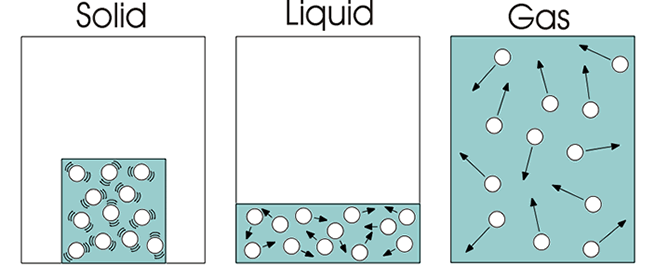
This classic state of matter can be difficult to see but it has some amazing properties.A long with liquids and solids, gases are one of the three major states of matter. Typically they result when a substance is heated in its liquid state to its boiling point, or when evaporation occurs from the surface of a liquid. There are numerous types and classifications of gases, including elements that naturally exist in a gaseous form, compound gases comprising more than one element, and mixtures of individual pure gases. Gas particles are much more loosely connected than those found in liquid or solid states, which results in lower density – and this is ultimately what sets a gas apart from the other two phases. Without changes in pressure or temperature, gas particles move around freely and randomly. They have no set shape and only change direction and momentum when bouncing off one another or off the inside of a container. Negatively charged areas of particles are attracted to positively charged areas – how these interact varies depending on the gas and are part of what makes each one unique. Because most gases are colourless, they are measured by four different : volume, temperature, pressure and number of particles; the latter property is more commonly known as moles. When put into a container (and not pressurised) gas molecules will evenly distribute themselves.

Thursday, 21 April 2016

How do Barcodes work? How machine reads barcode ?

Barcodes are a machine-readable way of writing letters and numbers. A laser is shone onto the barcode and the reflected light can be interpreted by the barcode reader. There are many types of barcodes, but the ones most commonly found in supermarkets use a row of lines of different widths. The different widths represent different numbers. In the UK many items are coded with a GTIN – Global Trade Item Number. This allows the manufacturer to print the barcode on the packages. The numbers are unique to that item. The barcode only has a number, but no product information. That is held in a database which the retailer can access at the point of sale. It also means that shops can set their own prices and change them easily.

What are the best colour inks to use in printers?

Suppose printers used red, green and blue ink instead. Which colours would you mix to make yellow? You couldn’t do it.Mixing red and green light gives yellow because you are adding together photons of different wavelengths.But with ink, you start with white ambient light and reflect it off the pigment molecules,which absorb some of the photons. So you are subtracting wavelengths, rather than adding them. The printer ink colours of cyan, magenta and yellow are used because they each absorb one of the primary colours – yellow ink absorbs blue light, and reflects red and green,for example

Can a compass work underground ?

Would a traditional compass work beneath the surface? The compass app on your phone probably won’t work because it relies on radio signals that are easily blocked by rock or water, but for a compass with a wobbly needle, it just depends on how far underground. A compass works because its magnetized needle lines up with the magnetic field that runs between Earth’s north and south poles, and that field is just as powerful if you go down a mine shaft or into the depths of the ocean. But the field is created by swirling molten iron in Earth’s core, and if you could drill that far down, you’d find your magnetic needle going haywire.

What’s inside a hard drive? Why are solid-state drives superseding hard-disk drives?

Hard-disk drives (HDDs) have been around since IBM conceived of the need for extra computer storage in 1956. A hard disk uses magnetised platters made of aluminium, ceramics or even glass to store data. These are typically rotated at 5,400 or 7,200 revolutions per minute for drives in home PCs. An arm that hovers just above the platters reads data from and writes data to the disk. SSDs,meanwhile, are built very much like the USB flash drives that have become popular over the last decade. There are no moving parts in an SSD, which helps it to access data significantly faster. SSDs use a type of memory called NAND, which is non-volatile: instead of writing a magnetic pattern to a ceramic substrate, it stores data as an electrical signal that it retains even after the computer is switched off. Each SSD features a small processor called a controller, which performs the same role as the read/write arm of an HDD.

Wednesday, 20 April 2016

Can cell phones work underwater? What’s needed to make these valuable devices waterproof?

Today there are two main methods for waterproofing a smartphone: physical barriers such as port covers and sealed seams that prevent liquid entering externally, and nanocoatings that penetrate the device entirely and actively repel water. While both techniques are used, the most effective is the latter, enabling devices to be water resistant without compromising on size and aesthetics.There are different types of nanocoating, but one of the most commonly used is that made by P2i. This company’s waterproofing process involves subjecting any electronic gizmo to a plasmaenhanced vapour in a vacuum chamber at room temperature. The vapour contains a gaseous polymer, which when brought into contact with the device’s surfaces – both external and internal – forms a super strong covalent bond and waterproof barrier 1,000 times thinner than a human hair. Once on the phone, the ultra-thin polymer layer then dramatically reduces its surface energy, forcing any water that comes into contact with it to bead up and be repelled. Obviously, in the case of a smartphone, this action would prevent water from penetrating the delicate internal components. However, due to the vapour disposition process, even if water were to penetrate the mobile’s casing, each internal component would also be coated with the polymer, protecting them until the water evaporated or was dried off manually.